


We are thrilled to announce Marta Schmidt (Legal track) as the 2026 GMD Writing Fellow! Marta will spend the next three months focusing on turning her thesis titled “Between a Rock and a Hard Place: Article 3 of the European Convention on Human Rights in the Context of Instrumentalisation of Migration at the EU-Belarus Racial Border” into a publication, with the support of her thesis supervisor, Dr Joseph Finnerty and GMD Legal Track coordinator Dr Moritz Jesse. Learn more about Marta, her thesis, and her future aspirations through this interview.
About the GMD Writing Fellowship: Every year, GMD students/recent graduates with (excellent) thesis results are encouraged to apply for the GMD Writing Fellowship. One writing fellow is selected through a selection procedure involving all GMD track coordinators. With financial, structural, and network support, the fellowship empowers GMD students/graduates to turn their (excellent) MA thesis into an academic article. This year, we have received very high-quality theses from multiple students. It was a tough decision to make, but the coordinators were able to select a fellow.
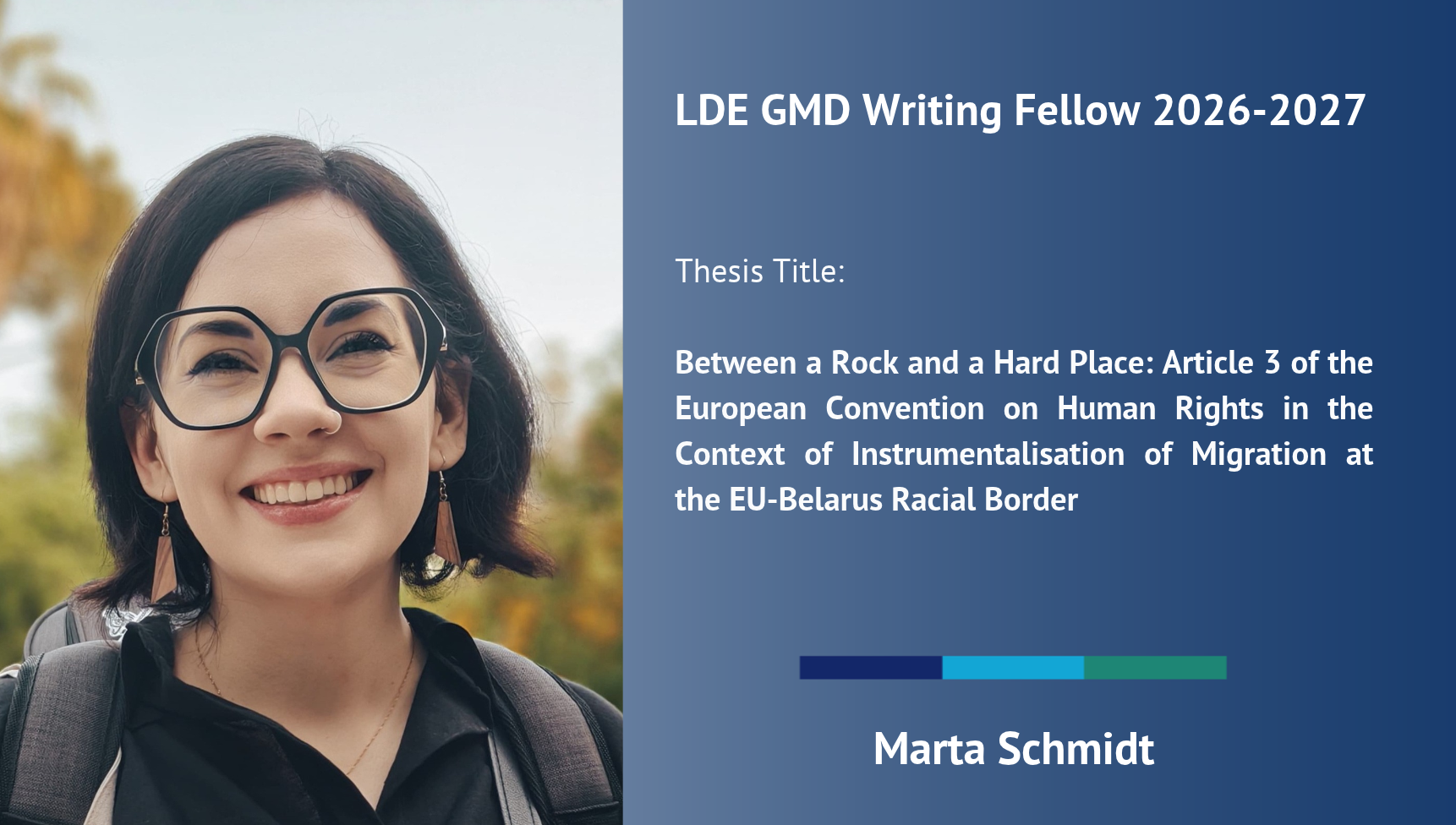
Congratulations on being selected as the 2026 GMD Writing Fellow, Marta! Could you tell us what brought you to the GMD master’s and share your academic journey thus far?
I started my academic journey in London in 2009, where I studied Politics and South Asian Studies at SOAS, University of London. I actually started my BA in Law and Politics, but I quit law after one year to pursue my great love for South Asia, including learning Hindi and Urdu. At SOAS, I received a Vacation Research Award, and I was able to conduct qualitative research with informal transport workers in Delhi, India for my thesis. SOAS really shaped who I am today — it taught me justice-driven critical thinking and unlearning Eurocentric presumptions about the world and people. I later completed an MSc in Development Management at London School of Economics. For my master’s thesis, I conducted qualitative research with informal transport workers in Lahore, Pakistan. The master’s opened me up to a career in development and humanitarian work, and I worked for over eight years in the sector, including in Iraq, Jordan, Libya and Palestine. Recently, I decided to go back to academia, and I enrolled in the legal track of the GMD master’s. Coming back to law after all these years has been like coming full circle. I have become passionate about migration after working all these years supporting people on the move and understanding the circumstances that may force people to undertake extremely dangerous journeys to safety and prosperity. Reading about growing racism and anti-migrant rhetoric in Europe, I decided that now it’s time to bring my experience and passion back to Europe.
As the Fellowship is intended to support you in turning your thesis into a submission for publication in an academic journal, could you tell us more about what you are working on? What was your thesis about?
My thesis examined the EU–Belarus border. The humanitarian crisis unfolding there since 2021, including in my home country of Poland, has really been the main push for my enrolment in the master’s. I wanted to better understand the violent responses of Poland, Latvia and Lithuania, as well as the EU, to the people coming through the green border. In my thesis, I focused on the three upcoming cases against the three frontier countries that are due to be adjudicated this year at the European Court of Human Rights. I examined what this litigation represents in terms of legal repercussions of the so-called ‘instrumentalisation’ of migration on human rights, specifically on the potential relativisation of the absolute prohibition of torture and inhuman treatment under the European Convention on Human Rights. I also discussed the problematic nature of understanding ‘instrumentalisation’ as a one-way phenomenon by contextualising and conceptualising the EU–Belarus border as a racial border, drawing on Achiume’s (2019) racial borders framework. I showed how it works to shelter the EU from its human rights obligations. My supervisor, Dr Joseph Finnerty, has really supported my first large piece of legal writing, and encouraged my critical approach throughout. I will never forget how, once I submitted my draft doctrinal analysis, he said, “now you are a legal scholar”. It was extremely motivating.
We are excited to read your thesis, which sounds intriguing and timely while also making a robust contribution to the current literature. So, finally, what are your future plans, and what are you hoping to achieve with the Fellowship?
I feel that the GMD master’s has really prepared me well for going back to academia — it was a very stimulating but also a challenging and intense year. I am hoping that the GMD Writing Fellowship will allow me to build my academic profile and further enhance my writing and research skills, so I can turn my thesis into a publication. I look forward to receiving further feedback and sharpening my analysis. As to my future plans, I am looking for a doctoral position that will appreciate my eclectic and multi-disciplinary background. I hope to work on research on migration that really contributes to improving people’s lives.
We are delighted to hear that you are interested in an academic career; the fellowship is a great leap forward, so once again, congratulations and welcome to the GMD family! Marta is keen to connect with LDE scholars and stakeholders working on migration, border governance, and human rights law throughout her Fellowship.