Design and Migration Societies:
Co-creating Just Futures
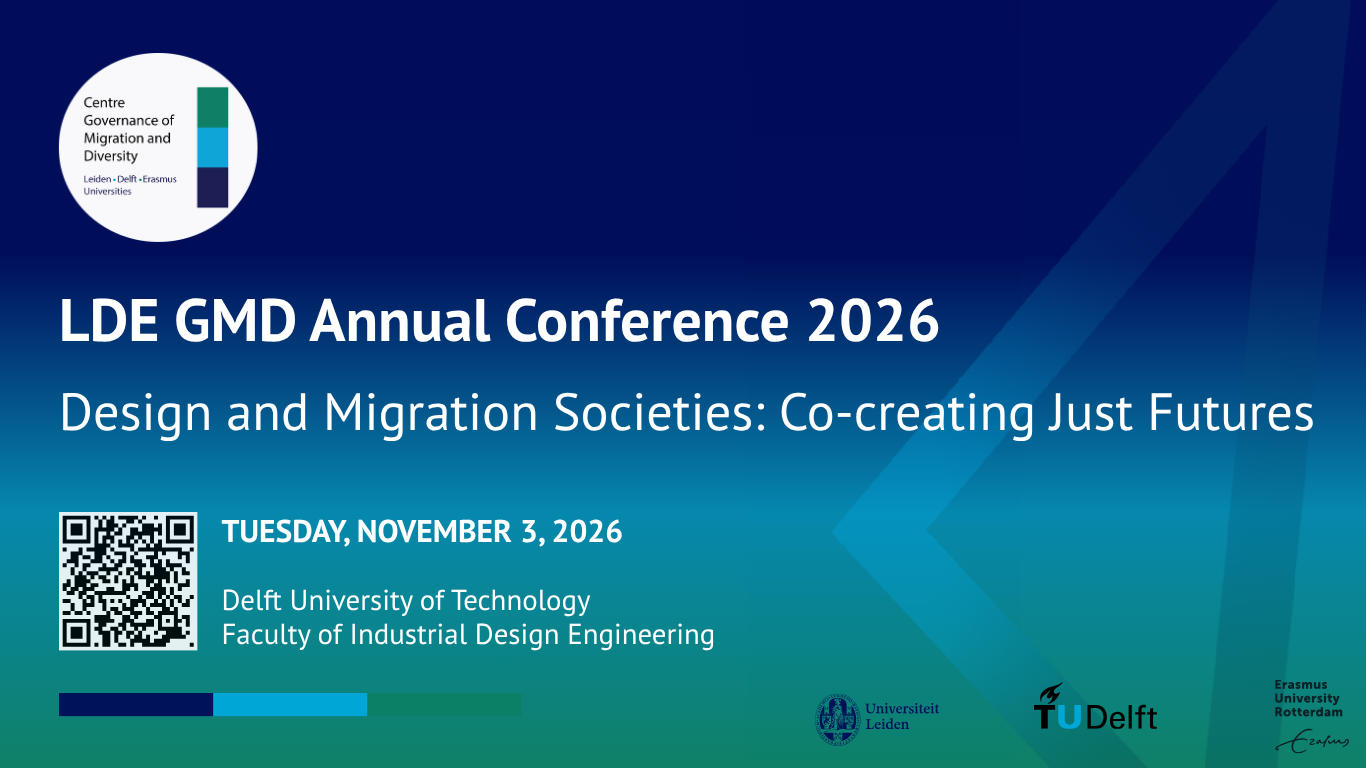
- Tuesday 3 November 2026
- 09:30 – 18:00
- Delft University of Technology (TU Delft) - Faculty of Industrial Design Engineering, Landbergstraat 15, 2628 CE Delft
Programme
The conference runs from 09:00 to late at the Faculty of Industrial Design Engineering, TU Delft. All rooms are on the 1st floor (balustrade), close to one another and to the Hall T - Origin (former Joost v.d. Grinten Hall). All breaks, lunch and drinks are served in the IDE foyer, where the pop-up exhibition is also on view. Signage will be in place on the day.
Full Programme - At a glance
09:00 · Registration (visit the exhibition in the IDE foyer)
Opening Plenary — Hall T - Origin (former Joost v.d. Grinten Hall)
09:45 · Welcome & short introduction
10:00 – 10:30 · Welcome roundtable
10:30 – 11:15 · Opening Keynote: The Materiality of Displacement
11:15 – 11:30 · Break — IDE foyer
Parallel Panels & Roundtable — 11:30 – 12:30 (five rooms, see below)
12:30 – 13:15 · Lunch — IDE foyer
Parallel Workshops — 13:15 – 15:15 (five rooms, see below)
15:15 – 15:35 · Coffee/tea break — IDE foyer
Closing Plenary — Hall T - Origin
15:35 – 16:00 · Award Ceremony Seed Funds
16:00 – 17:00 · Closing Keynote: Sasha Costanza-Chock, No Borders, No Nations, Stop Deportations
17:00 – 17:15 · Closing words
17:15 onwards · Networking drinks & book signing with Sasha Costanza-Chock — IDE foyer
Read full panel and workshop description here
Jump to: About · Opening Keynote · Closing Keynote · Programme · Panels & Roundtable · Workshops · Exhibition · Programme Committee
About the Conference
Migration has grown into one of the most controversial and polarising issues of our time. This reality is evident across many policy practices and societal domains: from shelter, reception and housing to education, employment, healthcare, security, and culture. Many professionals are confronted with its complexities, opportunities, and dilemmas. Yet, in public debate, migration is often reduced to an issue in its own right, separate from other societal challenges. This can obscure a clear understanding of the causes and consequences of migration, and can push the interplay between migration and, for example, the housing crisis and labour market exploitation into the background.
Migration is commonly studied from the perspectives of public administration, (inter)national law and security, history, economy and development studies. However, a design perspective is often missing from the debate. This conference will explore and showcase what design, as an interdisciplinary way of thinking and practice, can offer to our understanding of the governance of migration, diversity, and inequality, and particularly to co-creating just futures and societies. There are three conference lead subthemes.
Theme 1 – Designing for migration societies
Design-based thinking and practices can affect migration societies through specific spatial logics, material conditions, and forms of governance. Everyday life is shaped by these ongoing territorial, material, and social conditions from which migration and displacement emerge and are reproduced. Consider, for example, the concentration of greenhouse farming and the meat industry, that require substantial amounts of labour migrants. Design responses sometimes open limited possibilities and make everyday life easier, but more often, they may reinforce existing inequalities. This subtheme also explores whose knowledge counts (epistemic justice), how experiences are rendered visible or invisible, and how design can avoid reproducing extractive, Eurocentric frameworks. What does ‘designing for justice’ mean from a historic and legal perspective? And what can decolonisation mean for design-based thinking and practices?
Next to its historical relevance, designing also means futuring for migration societies: what kinds of futures are being imagined, by whom, and for whom? Examples may include repair and rebuilding (e.g., of war damage), political imagination, and the role of design in supporting futures grounded in spatial and epistemic justice rather than in mere crisis management.
Theme 2 – Designers for migration societies
Design is not a neutral act – it is always shaped by assumptions, intentions and goals. This implies the need to explore positionality, ethical perspectives, and practices of designers, as actors embedded in larger power webs. The role and positionality of designers in the context of migration societies raise questions about design agency, design justice, responsibility, accountability, and socio-spatial inequality. Who is protected, who is exposed, and who is held responsible? How do designers affect rules and legal frameworks? How does history shape designers' positionality?
This subtheme explores and opens the discussion on spatial justice, legal justice, reparative justice, epistemic justice, and the uneven distribution of responsibility across states, institutions, and actors.
Theme 3 – Design for migration societies
This subtheme explores outcomes, infrastructures, and material consequences. Designs, (designed) strategies, and their outcomes may manifest themselves in various ways in migration societies, for example, in asylum seeker centres, border walls, housing policies for status holders, databases, and laws, such as the Dutch Spreidingswet and the ‘Rotterdamwet’. Less visible but certainly influential are emergency settlement standards, or practices such as resource extraction, pollution distribution, and water governance that shape the spaces, ecologies, and infrastructures of migration.
Design plays an ambiguous role in contexts of conflict, migration, and displacement. It can reinforce exclusion and violence through refugee camps, borders, hostile infrastructures, militarised spatial arrangements, and technocratic governance, but it can also contribute to dignity, care, repair and rebuilding, and more just spatial and institutional responses. For example, how do design thinking and practice contribute to reparative infrastructures accountable to displaced communities?
Opening Keynote
The Materiality of Displacement: Entanglements of Design and Migration
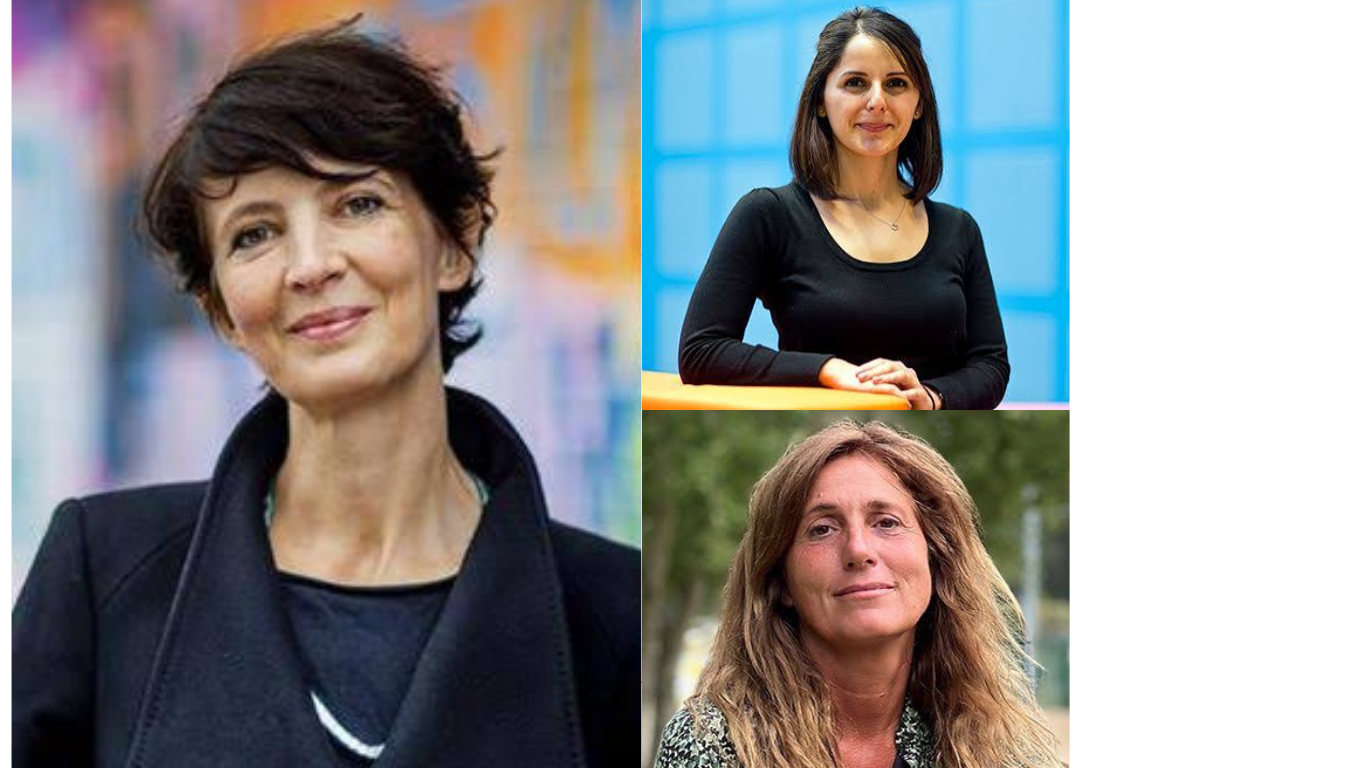
Speakers: Bregje F. van Eekelen, Değer Özkaramanlı, and Virginia Tassinari
Bregje F. van Eekelen, Değer Özkaramanlı, and Virginia Tassinari are part of the Society, Culture and Critique section of the Human-Centered Design Department at the Faculty of Industrial Design Engineering. Working across design, anthropology, philosophy, and history, they are interested in what happens when ideas, concepts, and ways of knowing travel between worlds. They follow knowledge as it moves — across disciplines, institutions, practices, and publics — and ask what happens to design when it encounters other ways of thinking and making.
Their work turns design methods into objects and instruments of inquiry: questioning their assumptions, opening them to ethical and political reflection, and experimenting with how they might change through encounters with social science and the humanities. They investigate how people, values, and ways of life are shaped through the worlds design helps bring into being, while also asking how design might make visible what those worlds otherwise leave unseen.
Together, they explore design not simply as a practice of making things, but as a way of knowing and intervening in social life: a practice through which concepts travel, worlds take shape, dilemmas surface, and possibilities for living otherwise can be brought into view.
Closing Keynote
Speaker: Sasha Costanza-Chock
We are pleased to welcome Sasha Costanza-Chock as the closing keynote speaker for the 2026 LDE GMD Conference. Sasha will also host a Queer Roundtable during the morning parallel sessions (see Programme below).
Sasha Costanza-Chock (she/they/ella/elle) is a researcher and designer whose work supports community-led processes that build shared power, dismantle the matrix of domination, and advance ecological survival. They are the Head of Research and Sensemaking at OneProject.org, a Faculty Associate with the Berkman-Klein Center for Internet and Society at Harvard University, and a member of the Steering Committee of the Design Justice Network. Their most recent book, Design Justice: Community-Led Practices to Build the Worlds We Need (MIT Press), is available Open Access at design-justice.pubpub.org.

Parallel Programme
Click here to read the full panel and workshop description
Panels & Roundtable — 11:30 – 12:30
Note: The following panels are cancelled: "Designing a Displacement-Sensitive Climate Vulnerability Framework and "Designing a Displacement-Sensitive Climate Vulnerability Framework". Please join an alternative panel below.
Queer Roundtable with Sasha Costanza-Chock — Room: Joost van der Grinten Hall
A conversation on queer world-building, design justice and solidarity across borders, hosted by our closing keynote speaker.
Co-Creating Migration Societies through Stories, Routes and Public Encounters — Room: IDE Arena
Meghann Ormond (Wageningen University and Research) and Caroline Newton. Storytelling, intercultural walking routes and public encounters as forms of co-creation and participatory design in migration societies.
How History Shapes Designers' Positionality: Lessons from the Bijlmer High-Rise — Room: IDE-studio 01
Pamela Ijeoma (Amsterdam Institute for African Mobility Studies) and Johnathan Subendran (TU Delft). The Bijlmermeer as a lens for examining how design assumptions are produced, inherited, and contested.
Launch of DIDI White Paper: Dilemmas of Diversity — Diversity Policy and Practice — Room: IDE-studio 02
Eight dialogues between sixteen experts from academia, government and civil society on current dilemmas in diversity policy and practice.
Cultivating Responsible Research Relationships in an Era of Tech-Savvy Migration Research — Room: IDE-studio 03
Dr. Zeynep Kasli and Dr. Nanneke Winters (ISS, Erasmus University Rotterdam), with Dr. Bernd Kasparek (TU Delft) and Dr. Lieke van der Veer (EUR / TU Delft). Digital infrastructures, diversity policy audits, and responsible research in an era of tech-driven migration governance.
Workshops — 13:15 – 15:15
Designing the Future of Migration Studies in the Netherlands — Room: Joost van der Grinten Hall
Nadia Bouras (Leiden University), Ilse van Liempt (Utrecht University), Peter Scholten (Erasmus University), Han Entzinger (Erasmus University), Marlou Schrover (Leiden University), Rinus Penninx (University of Amsterdam), Halleh Ghorashi (Free University of Amsterdam), Laura Cleton (Erasmus University), Maartje van der Woude (Leiden University) and Leo Lucassen (Leiden University). Fifty years of migration research — reflecting on the field and collectively designing its future directions.
Shapes of a Future-proof Labour Migration System in the Netherlands: Lab with the IND — Room: IDE Arena
Michiel Swinkels and Diana Stefanescu (IND, Judith van Uden (Radboud University) - Co-designing new labour migration procedures around policy dilemmas at the intersection of demographic change, economic transformation, and implementation.
Design and Migration: A Transdisciplinary Dialogue to Challenge Methodological Blindspots — Room: IDE-studio 01
Alessandra Bernardi and Deger Ozkaramanli (TU Delft, IDE), Moritz Jesse (Leiden University), and Matthijs van Dijk (Reframing Studio). Using a futures matrix as a boundary object to critically reflect on positionalities, biases and values in migration-related design methodologies.
Design Your Future: Speculative Design with Youth in Delft West — Room: IDE-studio 02
Leonie Sonneveld and Eveline Holla (ScienceHub TU Delft), with Can I Dream, Wijkuniversiteit TU Delft, and Canan Mesutoglu (EUR). Speculative design as a participatory approach for engaging young people with a migration background in imagining more inclusive urban futures.
Typologies of Migration: A Critical and Explorative Design Charrette — Room: IDE-studio 03
Johnathan Subendran, Marh Echtai and Irene Luque Martin (TU Delft, Faculty of Architecture). A design charrette treating form-making as a site of politics, using creative destruction through an intersectional lens.
Pop-up Exhibition
The conference features a pop-up exhibition showcasing what designers, design (research) processes, and design as an outcome entail and how they could contribute to research and design for migration societies. Most projects in this exposition are from scholars and students affiliated with TU Delft. They aim to raise dialogues, stimulate critical (design) thinking, and transdisciplinary cooperation. The exhibition is open throughout the day in the IDE foyer; visitors are encouraged to drop in during breaks and over lunch.
Programme Committee
Convenor and conference chair: Reinout Kleinhans (Faculty A&BE).
Co-convenors: Alex Huang & Maria Schiller (LDE GMD Executive Office).
Members: Annemiek van Boeijen (Faculty IDE), Marh Echtai (Faculty A&BE), Antonio Cantero (Faculty A&BE), Dirim Dinçer (Faculty A&BE), Srijith Balakrishnan (Faculty TPM), Johan Ninan (Faculty CEG).
Contact: For questions about the conference, please contact the LDE GMD Executive Office: gmdcentre@essb.eur.nl